
Finding a Shape with a Surface Area to Volume Ratio of 1
By Sophia Bowman
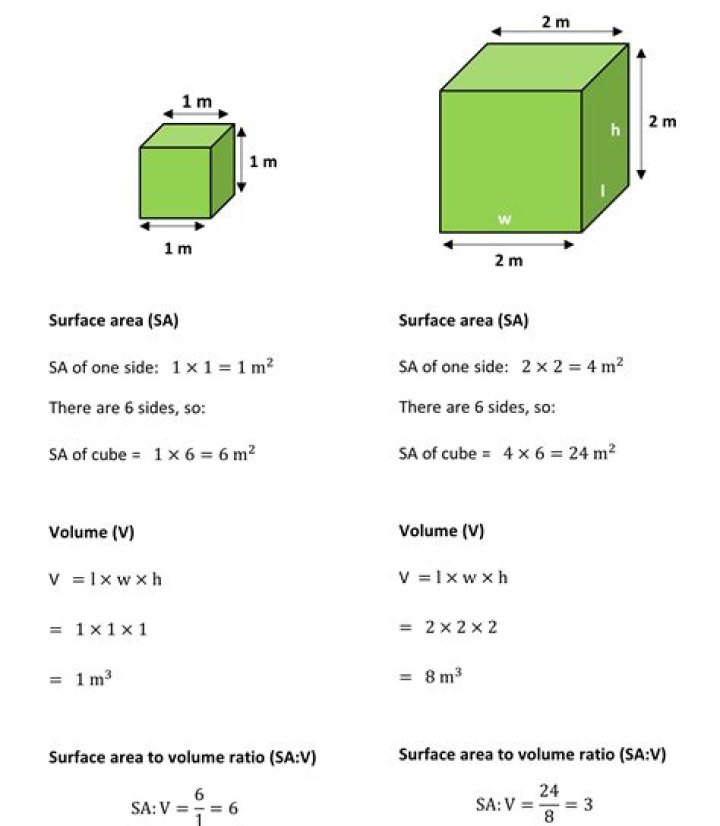
Background
Conventionally, the square-cube law maintains that as the length scale of a regular shape increases, the surface area-to-volume ratio will dimish to zero. A cube with side length $l$, for example:
$$\lim_{l\to\infty} \frac{SA}{V} = \lim_{l\to\infty} \frac{6l^2}{l^3}=0$$
Interestingly, there exists at least one shape in which the opposite is true, where the surface area-to-volume ratio is unbounded. This shape is Gabriel's Horn. It is the shape defined by revolving the function $y=\frac{1}{x}$ about the x-axis, taken from $x=1$ to some end point.
For Gabriel's Horn, we have:
$$\lim_{x\to\infty} \frac{SA}{V} = \lim_{x\to\infty} \frac{\int\limits_{1}^{x} 2\pi \frac{1}{x}\sqrt{1 + \frac{1}{x^4}} dx}{\int\limits_{1}^{x} \pi \frac{1}{x^2} dx}$$
For the numerator, $\frac{1}{x} \sqrt{1 + \frac{1}{x^4}} > \frac{1}{x}$ because the term $\sqrt{1 + \frac{1}{x^4}} > 1$. Thus, if we rewrite the integral to make it easier to solve:
$$\lim_{x\to\infty} \frac{2\pi \int\limits_{1}^{x} \frac{1}{x} dx}{\pi \int\limits_{1}^{x} \frac{1}{x^2} dx} = \lim_{x\to\infty} \frac{2\pi (\ln{x} - \ln{1})}{\pi (\frac{1}{1} - \frac{1}{x})}=\frac{\infty}{1}=\infty$$
Because the actual numerator is greater than the substituted term, Gabriel's Horn has an infinite surface area-to-volume ratio.
Question
Is there a shape such that the surface area-to-volume ratio, as a characteristic length increases, approaches 1?
Relevancy
Perhaps this is of mathematical interest on its own, but it also has important applications, especially within engineering (my field of expertise). Heatsinks, for example, have mass proprotional to their volume but their cooling efficacy is roughly proportional to their surface area. In this case, a high ratio is preferred. In certain chemical reactions, heat is produced by the reaction. Heat also tends to catalyze reactions, so a low ratio would result in a faster reaction since less heat is lost from the exposed surface area and more is generated from the increased volume. There are times when a system is difficult to scale because of how the square-cube law affects performance metrics in a disproportionate way, so a ratio of 1 would allow for infinite scalability with proportional cost and performance.
My knowledge of mathematics is fairly limited, but I believe this also has applications to fractals (which in turn have applications to antennae), which often behave similarly to Gabriel's Horn in how their ratios behave.
$\endgroup$ 51 Answer
$\begingroup$There can definitely be shapes of other kinds that are interesting, but constructs similar to Gabriel's horn (revolving along the $x$-axis) already provides more than what you originally asked for.
Consider the profile of the family of 2-parameter exponential decay $y = b e^{-ax}$ for $x \in \mathbb{R}^{+}$ (not starting at $x = 1$ but at $x = 0$), The surface area of the solid of revolution and volume up to $x = u$ are the following.
\begin{align} A_u &= 2\pi \int_{0}^u be^{-ax} dx = 2\pi b\frac{1 - e^{au}}a & A_{\infty} \equiv \lim_{u \to \infty} A_u = \frac{ 2b }a \pi\\ V_u &= \pi \int_{0}^u b^2e^{-2ax} dx = \pi b^2\frac{1 - e^{2au}}{2a} & V_{\infty} \equiv \lim_{u \to \infty} V_u = \frac{ b^2 }{ 2a } \pi \end{align}
From this one can have whatever ratio desired. For a given $r \in \mathbb{R}^{+}$ of any value $$\text{Solve}~~ \frac{ A_{\infty} }{ V_{\infty} } = r \quad \implies \quad \frac4b = r \quad\text{or} \quad b = \frac4r$$In particular, for $r = 1$ we have $b = 4$ yielding a horn with infinite characteristic length which finite surface area equals its volume.
Note that the rate $a$ in the exponent cancels and is unimportant and all one needs is the scaling parameter $b$ (in this particular application).
It's clear that due to the fast decay of the exponential profile, the area and volume are finite.
On that note, it's easy to show that the original classic Gabriel's horn of $y = x^{-a}$ with $a = 1$ is at the critical point. For any $a \leq 1$ the area is gonna be infinite (and for below another critical point $a = 1/2$, the volume is infinite as well). For any real-valued $a > 1$ one gets a finite area-to-volume ratio $\frac{2a - 2}{2a - 1}$, which can get closer to one with larger $a$ but never gets there. This reflects the basic fact that "exponential grows/decays faster than any finite polynomial".
Meanwhile, if the 2nd parameter is included for the polynomial family $y = bx^{-a}$, then one can similarly have any area-to-volume ratio one wants (with $a > 1$).
$\endgroup$